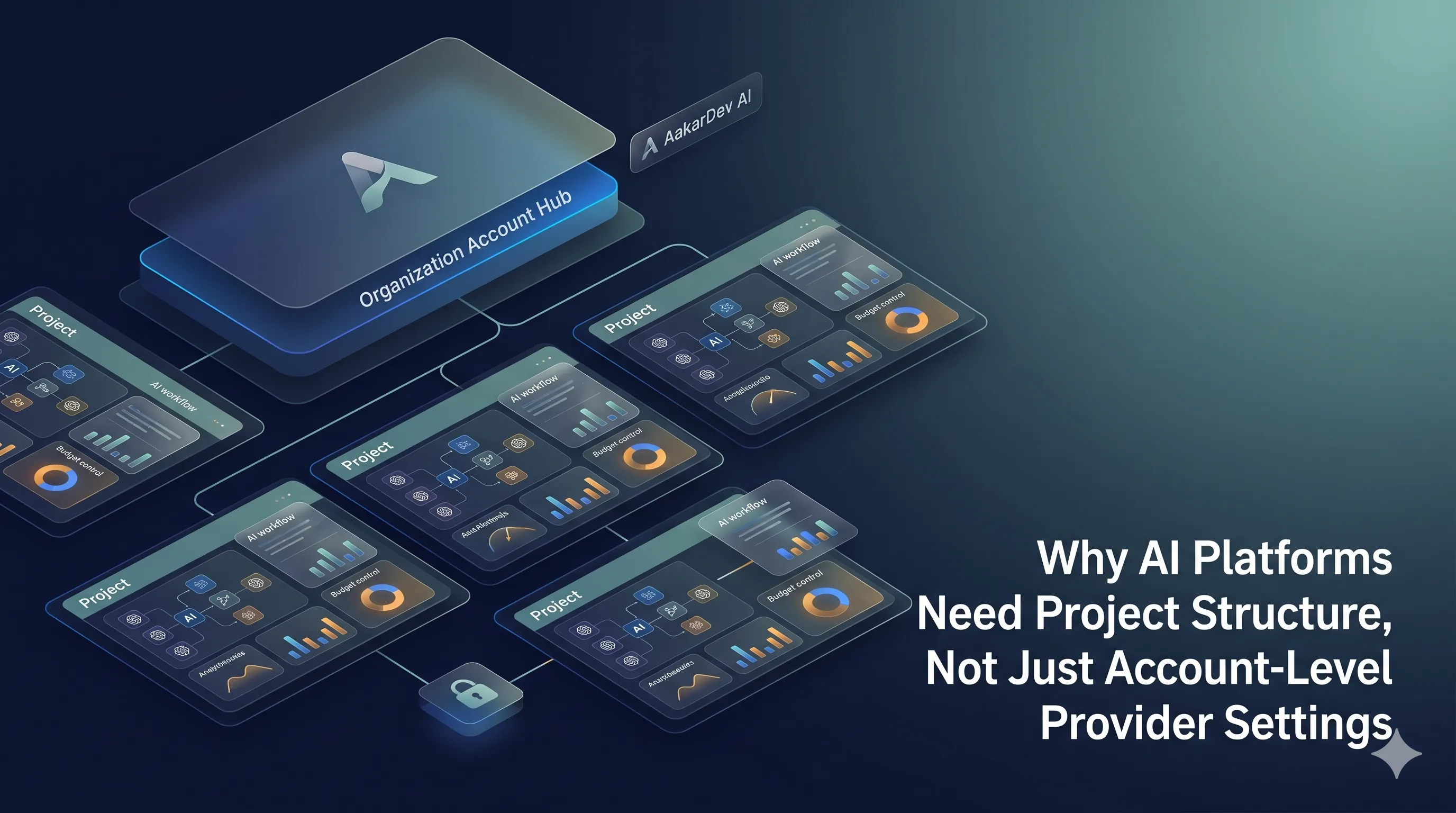
Why AI Platforms Need Project Structure, Not Just Account-Level Provider Settings
The Problem with “Just Set It at the Account Level”
At first, account-level provider settings feel clean and convenient. Add one OpenAI key, one Gemini key, choose a default model, and every request in the account uses that setup.
That works for a demo. It does not work well for a real business.
As soon as a team is serving multiple apps, clients, environments, or internal departments, account-level settings turn into a bottleneck. Everything gets forced through one shared configuration, even when the actual work is very different.
The result is predictable:
- Teams lose isolation
- Costs become hard to attribute
- Experiments become risky
- Governance becomes messy
- One provider decision affects unrelated workloads
If your platform only thinks at the account level, it cannot reflect how companies actually build and operate AI products.
AI Workloads Are Not All the Same
A support chatbot, a document extraction pipeline, and a premium reasoning workflow should not all share the same provider setup just because they belong to the same company account.
Different workloads usually need different combinations of:
- Models
- Providers
- Rate limits
- Budgets
- Logging rules
- Fallback behavior
- Access controls
An account is too broad to carry those decisions well. A project is the right unit.
Projects map much better to reality:
- One product
- One client
- One environment
- One business function
- One team with clear ownership
That structure makes decisions easier because settings live close to the workload they control.
Shared Account Settings Create Operational Confusion
When every provider key and model rule is managed globally, small changes start having oversized consequences.
For example:
- The marketing team wants to test a cheaper model
- The enterprise team needs stricter logging and data controls
- One client requires region-specific routing
- A new internal tool should use Gemini, while an existing workflow should stay on OpenAI
With only account-level settings, these needs collide. Now someone has to choose between adding hacks, duplicating accounts, or introducing manual process around a system that was supposed to simplify operations.
This is how platforms become fragile.
Project Structure Gives You Isolation Without Fragmentation
Project-level architecture solves the problem cleanly.
Instead of treating the entire account as one giant AI workspace, you create isolated project containers inside it. Each project can have its own:
- Provider keys
- Default models
- Routing rules
- Budget limits
- Usage analytics
- Team permissions
- Webhooks and integrations
That gives you separation where it matters, without forcing customers to create completely separate accounts for every use case.
In other words:
- The account becomes the umbrella for organization and billing
- The project becomes the operating unit for execution and control
That is a much more scalable model.
Billing and Analytics Need Project Boundaries
One of the biggest weaknesses of account-level provider settings is that usage data becomes too blended.
If five teams share the same provider configuration, it becomes difficult to answer simple questions:
- Which app is driving spend?
- Which client is most expensive to serve?
- Which experiment increased token usage?
- Which workflow should be optimized first?
Project structure fixes that by giving every request a natural reporting boundary.
Now costs can be tracked per product, per client, per team, or per environment. That makes finance, operations, and engineering much easier to align around the same numbers.
Without project-level visibility, optimization becomes guesswork.
Governance Is Easier When Ownership Is Clear
Security and compliance are also much easier with projects.
Not every team should have access to every provider key. Not every workflow should inherit the same retention or routing behavior. Not every developer should be able to change production AI settings for unrelated systems.
Project structure lets you define ownership more precisely:
- This team can manage staging only
- This client project uses its own BYOK credentials
- This production workflow has restricted settings
- This sandbox project is allowed to experiment freely
That is much harder to do safely with only global account-level settings.
Project-Level Routing Unlocks Better AI Products
The real power of project structure is not only governance. It is product quality.
The best AI platforms do not assume one provider or one model is right for everything. They allow each project to choose the setup that matches its goals.
For example:
- A low-cost internal assistant can prioritize speed and price
- A legal analysis workflow can prioritize reasoning quality
- A multilingual support product can optimize around a provider’s language strengths
- A client-facing app can use failover rules that are different from internal tooling
That kind of routing flexibility is hard to manage at the account level because every exception becomes a special case.
At the project level, it becomes normal configuration.
Projects Also Make BYOK Much More Practical
Bring Your Own Key sounds simple until multiple teams or clients are involved.
If keys only exist at the account level, you quickly run into awkward questions:
- Which client owns which usage?
- How do you separate customer-provided credentials?
- How do you rotate one key without affecting other workloads?
- How do you test a new provider safely?
Project-based design gives BYOK the structure it needs.
Each project can connect its own provider credentials and policies without contaminating the rest of the account. That creates cleaner isolation for both internal teams and external customers.
The Right Mental Model
Think of it this way:
- Account level is for organization-wide identity, billing umbrella, and high-level administration
- Project level is for execution, routing, ownership, reporting, and control
If everything lives at the account level, your AI platform stays simple only until real usage begins. After that, simplicity turns into rigidity.
Project structure is what lets a platform stay organized as it scales.
Build for the Way Teams Actually Work
Companies do not build one AI workflow forever. They build many workflows, for many teams, with different goals, budgets, risks, and providers.
That is why project structure is not an extra feature. It is core infrastructure.
If you want an AI platform that supports multi-model routing, BYOK, clean billing, safer experimentation, and real operational ownership, project-level architecture is the foundation.
Account-level provider settings are a good starting point. They should not be the end state.
Was this article helpful?